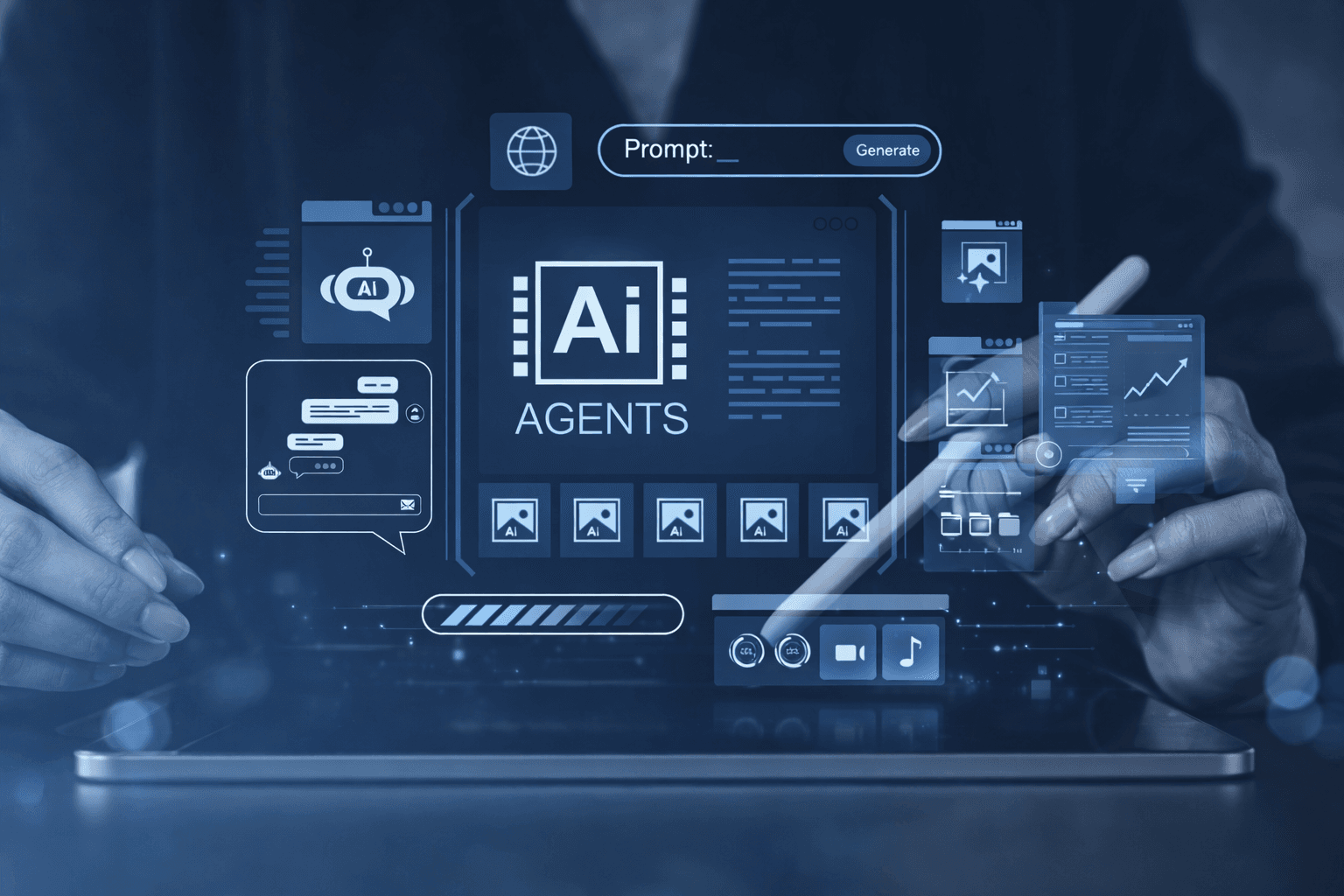
The AI Evolution
Software systems have evolved dramatically over the past decade. What began as simple rule-based automation has transformed into sophisticated AI-driven platforms capable of understanding context, making decisions, and learning from interactions. At the forefront of this evolution are AI agents—autonomous systems that are reshaping how software operates and how businesses interact with technology.
Modern enterprises face unprecedented challenges: managing massive data volumes, delivering instant responses, and providing personalized experiences at scale. Traditional software approaches struggle to meet these demands. AI agents introduce a new architectural layer into software systems—one that combines reasoning, memory, and tool execution. Instead of encoding every possible path in deterministic logic, modern systems can delegate goal-oriented tasks to agents that interpret intent, plan actions, call external services, and adapt dynamically based on results. This shift changes not just user interaction, but how backend systems are designed and orchestrated.
The Shift: We are moving from deterministic service layers to probabilistic reasoning layers. Traditional systems execute predefined logic. AI agents evaluate context, generate plans, use tools, and revise actions in real time. This represents a structural shift in software architecture, not just a UX upgrade.
Bots vs. Agents: Understanding the Difference
Not all AI assistants are created equal. The terms "chatbot" and "AI agent" are often used interchangeably, but they represent fundamentally different capabilities. Understanding this distinction is crucial for choosing the right solution for your needs.
Chatbots
Rule-Based Systems
Operate using predefined scripts and decision trees
Best for FAQs and straightforward tasks
Cannot understand context beyond their programming
Fast deployment with minimal setup
AI Agents
Intelligent & Autonomous
Powered by large language models (LLMs)
Understand nuance, context, and conversation history
Execute complex workflows autonomously
Integrate with external systems via APIs
Side-by-Side Comparison
Chatbot Response:
"Yes, this product is in stock. Would you like to purchase it?"
AI Agent Response:
"I've checked our 3 nearby locations. The blue version is in stock downtown, but based on your previous purchases, you might prefer the green variant—I can arrange free express delivery from our warehouse."
The key difference? Chatbots follow instructions, while AI agents understand intent and adapt their approach. This fundamental distinction determines which solution fits your business needs.
Practical Applications
AI agents are reshaping how modern software systems are architected and operated, acting as dynamic coordinators across services, data layers, and user interfaces.
Intelligent Customer Interaction
Modern AI agents have revolutionized customer support. Unlike traditional chatbots that break down when questions deviate from their scripts, AI agents understand intent and context. They can handle ambiguous queries, maintain conversation threads across multiple interactions, and even detect customer sentiment to adjust their tone accordingly.
Brands like Decathlon use chatbots on platforms such as Facebook Messenger to engage customers—guiding product selection, answering common questions instantly, and recommending tailored solutions. With AI agents, these interactions become more dynamic and adaptive, delivering 24/7 support without long wait times. Many organizations report double-digit improvements in customer satisfaction and significant reductions in support costs, particularly for high-volume, repetitive queries.
Workflow Automation
AI agents excel at orchestrating complex, multi-step business processes. They translate unstructured intent into structured execution plans, dynamically selecting which internal services, APIs, or workflows to invoke—effectively functioning as an intelligent orchestration engine. For instance, processing a customer refund involves verifying the order, checking return policies, updating inventory, initiating payment processing, and notifying relevant teams—all handled in seconds.
What makes them powerful is their ability to handle exceptions intelligently. When they encounter edge cases or ambiguous situations, they can reason through the problem, consult business rules, and make informed decisions—or escalate to humans when necessary. This level of automation frees teams to focus on strategic work rather than repetitive tasks.
Real-Time Analytics & Insights
Advanced agents analyze data streams in real-time, identifying patterns and anomalies that humans might miss. They provide actionable insights, predict trends, and recommend optimizations—turning raw data into strategic advantage. More importantly, they can explain their findings in natural language, making complex analytics accessible to non-technical stakeholders.
These agents don't just report what happened—they predict what's likely to happen next. For example, they might detect early signs of customer churn, identify which retention strategy would be most effective for that specific customer, and even draft the outreach message automatically. This proactive intelligence helps organizations make better decisions faster.
Cross-Platform Operations
Modern enterprises run on dozens of disconnected systems—CRMs, ERPs, marketing platforms, databases, and legacy applications. AI agents serve as intelligent middleware that bridges these systems seamlessly. They understand the data models and APIs of each platform, translating and synchronizing information without manual mapping or custom integrations.
Beyond basic data transfer, these agents maintain consistency, resolve conflicts, and ensure data quality across platforms. When a customer updates their address in one system, the agent propagates that change everywhere it's needed while respecting each system's specific requirements and validation rules. This creates seamless customer experiences while optimizing backend operations automatically.
Personalization & Adaptive Learning
AI agents excel at creating deeply personalized experiences by learning from every interaction. They build detailed user profiles—not just demographic data, but behavioral patterns, preferences, communication styles, and context-specific needs. This allows them to tailor every response, recommendation, and action to the individual user.
What sets AI agents apart is their ability to adapt in real-time. If a user's preferences change, the agent detects and adjusts immediately. If a particular approach isn't working, it tries different strategies. This continuous learning loop means the system gets smarter with every interaction, delivering increasingly better outcomes over time without requiring manual retraining or updates.
Strategic Value
The adoption of AI agents represents more than a technology upgrade—it's a strategic transformation that affects every aspect of business operations.
Enhanced User Experience
Deliver personalized, context-aware interactions that users expect from modern software.
Operational Efficiency
Automate complex processes that previously required human oversight and decision-making.
Scalability
Handle growing workloads without proportional increases in infrastructure or headcount.
Continuous Learning
Systems that improve over time, learning from every interaction and outcome.
Competitive Differentiation
Deliver capabilities that set your products apart in increasingly commoditized markets.
The Future
We're still in the early stages of the AI agent revolution. Current implementations, while impressive, represent only a fraction of what's possible as the underlying technologies continue to advance rapidly.
The defining challenge for modern software teams is not whether to adopt AI agents, but how to design systems where agents become first-class architectural components—coexisting with APIs, databases, and microservices as core building blocks. Organizations that move decisively now will establish advantages that compound over time—both in technical capability and institutional knowledge.
The Path Forward
The next generation of software systems will not be defined solely by features, but by their ability to reason, adapt, and orchestrate autonomously. Organizations that design for this shift—treating AI agents as an architectural primitive rather than a feature—will define the next era of software engineering.