From Conversations to Operations: The Future of Business Software
 Rupesh Chaulagain·AI Engineer, Novelty Lab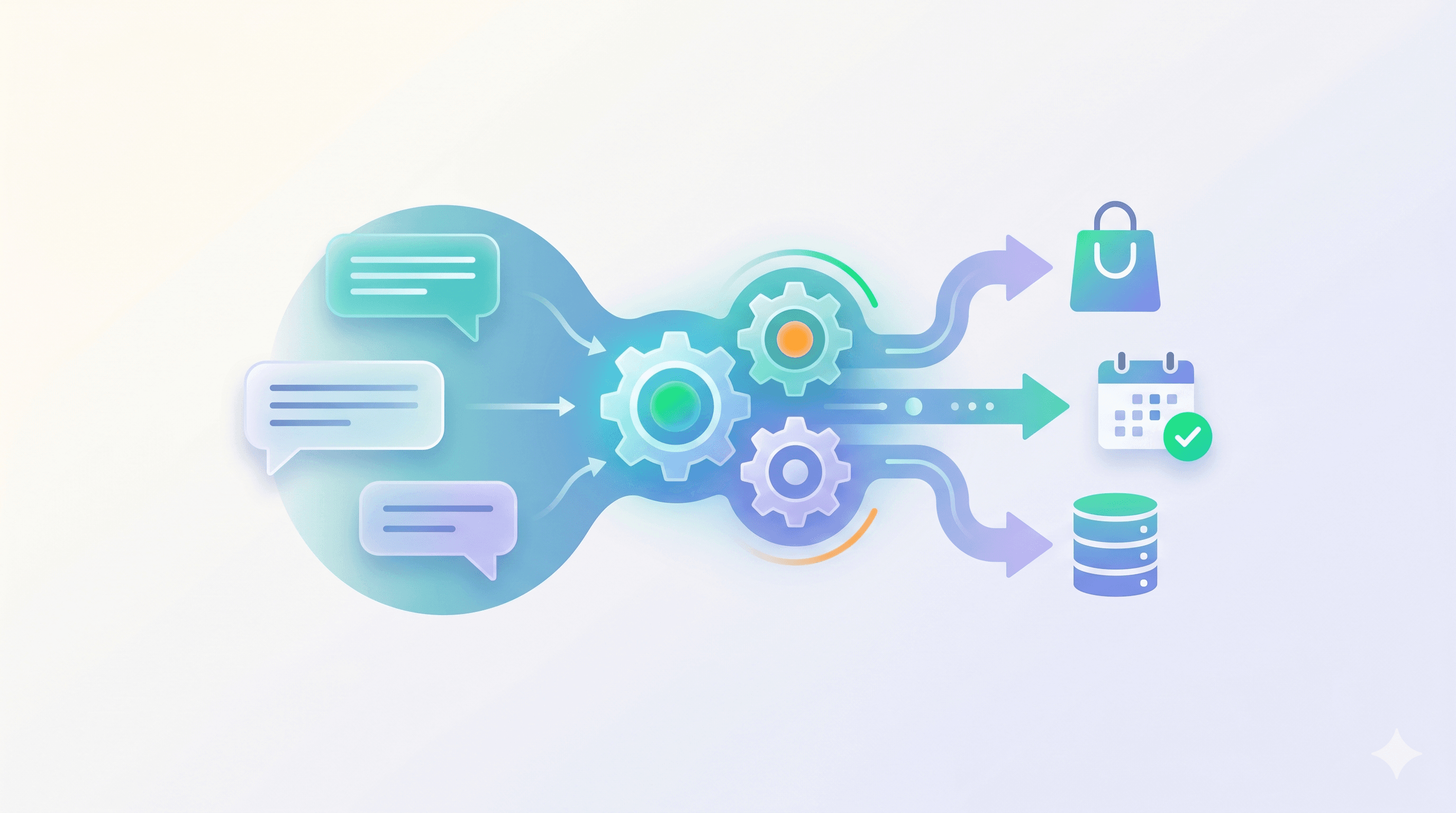
Every day, customers are sending messages asking if a product is in stock, checking service availability through your website chat, or wanting to know your return policy before they commit. These are not support tickets. They are buying signals arriving through conversational channels, in real time, every day. But most businesses have no system behind the conversation. A human reads the message, manually checks the information, types a reply, and hopes the customer is still interested.
When volume grows, responses slow down. Leads go cold. Bookings get missed and the business has no record of any of it.
That is the gap. Not the number of channels. The absence of operational intelligence behind the ones you already use. Today, a message is no longer just a message. It is a conversion opportunity, a booking intent, a support request — and the businesses that build systems to recognize and act on that in real time will not simply respond faster. They will operate differently.
The Old Business Stack Is Breaking
For years, business software was designed around isolated tools and manual coordination.
A customer inquiry came in. A human checked inventory manually. Another employee confirmed availability. Someone updated a spreadsheet. Someone else followed up later, often after the customer had already moved on.
That model worked when communication moved slowly. It breaks down in an environment where customers expect businesses to respond with speed, continuity, and awareness. Today, customers expect systems that remember context, understand intent, and follow through without repetition. But most businesses still rely on fragmented software stacks that were never designed to operate this way. In many companies, employees have effectively become the integration layer between software systems.
That is no longer scalable. A customer asking whether a product is available should not require someone to manually check inventory, copy information into another system, and send a follow-up message, hoping the customer is still interested by the time it arrives. These are not communication problems. They are operational coordination problems. And this is why the next generation of business software will not simply add AI chat interfaces on top of existing workflows. It will connect conversations directly into operations.
A Message Is No Longer Just a Message
A customer asking about pricing is not just a message. It is a conversion opportunity. A customer asking whether a service slot is available next week is not starting a conversation. They are expressing intent.
This changes how businesses should think about communication entirely.
Conversations are operational inputs. Product inquiries can become orders. Service questions can become bookings. Support requests can trigger workflows. The businesses gaining advantage today are not simply responding faster. They are building systems that understand what conversations actually represent and act on them.
Consider a hospitality business managing multiple venues. A customer asks whether a venue is available for an event next month. Traditionally, staff may need to check calendars, confirm availability, gather requirements, and follow up manually. Every delay increases the risk of losing the opportunity. In an operationally integrated system, the conversation itself becomes the trigger. Availability can be checked automatically, event requirements collected through structured workflows, and qualified inquiries routed directly to the right team. The conversation does not stop at answering a question. It becomes the beginning of an operational process.
A customer asking about a jacket on Instagram should not require a salesperson to manually copy details into another system before a follow-up happens. The inquiry, the product context, the customer's intent — all of it should flow directly into an outcome: a recommendation, a checkout link, a booking slot, or a handoff to a human. That is what operational communication actually looks like.
Why General Chatbots Are Not Enough
Many businesses have already experimented with chatbots. Most of them did not create meaningful operational value. The problem was not AI itself. The problem was that most chatbot systems were designed as isolated conversation tools rather than integrated operational systems.
But there is a deeper problem that rarely gets talked about honestly: most chatbot systems are also brittle by design.
When an external API goes down, they fail silently. When the language model times out — which happens more than vendors admit — they return a generic error or simply go quiet. When a conversation spans multiple steps, any interruption means starting from scratch. The customer gets no closure. The business gets no record. The workflow disappears.
Real business workflows require something different. They require a runtime that owns the conversation state, not the model. Memory lives in application infrastructure. The AI receives a structured slice of relevant context on each turn. If the model times out, the conversation does not vanish — the state is preserved, the step is retried, and the customer experience continues.
Long-running workflows like booking confirmations, order follow-ups, and multi-step qualification flows need to survive failures automatically. By nature, AI systems require time: they wait for external responses, pause between steps, retry when something fails, and resume exactly where they left off. A system that cannot do this does not work in production. It only works in a demo.
- API failures mid-flow abandon customers with no recovery path.
- LLM timeouts force users to re-explain themselves.
- Without an audit trail there is no way to know what the AI said, decided, or promised when something goes wrong.
These are the daily operational costs of treating AI as a conversation layer instead of an operational layer.
AI-Native Workflows and Structured Operations
The most effective AI systems are not driven entirely by prompts. They are driven by structured business context and operational logic.
A well-designed system understands business hours, service types, return policies, customer history, product catalogs, and operational constraints. It maintains structured state across a conversation: pending orders, unfinished bookings, customer preferences, confirmation status. It does not rely on the model to remember. It relies on the system.
This creates a fundamentally different customer experience. Instead of restarting every interaction from scratch, businesses can build continuity into communication itself. A customer who started a booking on Monday and returned on Thursday does not have to re-explain who they are. More importantly, AI systems built this way can become proactive — automatically triggering booking flows, surfacing relevant products, routing high-intent leads to a human, or scheduling follow-ups without anyone manually intervening. Critically, every one of those actions is logged, auditable, and reversible.
Not every conversation should be resolved by AI. The system should recognize when a situation requires human judgment and route it there cleanly, without the customer noticing the transition.
This is where commerce, communication, and operations begin merging into something new.
Why Businesses Need Systems Built Around Them
Most businesses today operate through disconnected SaaS tools assembled over time. One platform handles messaging. Another handles bookings. Another stores customer data. Teams spend their days manually coordinating between systems that do not truly reflect how the business actually works. In many cases, the software does not serve the business. The business serves the software.
Every business operates differently. The way a lead is qualified, a booking is confirmed, an escalation is handled, or a customer is followed up with is specific to that business and no other. Generic tools are built for the average use case. But no business is average. As AI becomes a deeper part of how businesses operate, this specificity matters even more. A generic AI layer on top of a generic tool stack does not solve the coordination problem. It adds another layer to coordinate.
Custom systems built around actual operational needs, with communication, workflows, and intelligence working together, give businesses something generic software cannot: coherence. The system reflects how the business works. The AI acts on behalf of the business faithfully, not approximately. That is not a case for custom software as a luxury. It is a case for systems that actually fit. And as AI makes it faster and more accessible to build software around specific operational needs, the old assumption that businesses must adapt their operations to generic software is becoming increasingly difficult to justify.
Where Business Software Is Heading
Software is no longer just a place to store and manage information. Every layer of it is beginning to incorporate intelligence — not as a feature, but as a foundation. Businesses are not just looking to move faster. They are looking for systems that understand context, reduce manual effort, and turn everyday interactions into operational outcomes. Conversations, workflows, and intelligence are converging into one layer, and communication itself is becoming infrastructure.
Over time, businesses will spend less effort coordinating information between people and systems, and more effort acting on insights generated by those systems. Many of the operational tasks that consume time today — follow-ups, qualification, routing, scheduling, and information retrieval — will increasingly become part of the infrastructure itself rather than responsibilities handled manually.
The businesses that succeed will not simply be the ones using AI. They will be the ones that redesigned their operations around it — with systems built to handle failure gracefully, preserve state reliably, act on intent accurately, and hand off to humans when it matters. The line between communication software and operational software is rapidly disappearing.
That shift has already started. The opportunity is real, the tools are maturing, and the businesses building now will be the ones best positioned for what comes next.
Frequently Asked Questions
Will generic AI tools be enough for most businesses?
Generic AI tools can provide value, especially for simple use cases. However, as businesses grow, operational complexity becomes the challenge. Different businesses have unique workflows, approval processes, customer journeys, and operational constraints. The greatest value often comes from systems that are tailored to how a specific business operates rather than forcing the business to adapt to a generic tool.
What should businesses focus on first when adopting AI?
The best starting point is not the AI model itself. It is identifying operational bottlenecks. Businesses should look for areas where information is repeatedly transferred between people, where customers experience delays, where workflows rely on manual coordination, or where opportunities are frequently missed. Solving these operational problems usually creates far more value than simply adding AI to an existing process.
What's the difference between a chatbot and an AI operational system?
A chatbot primarily focuses on generating responses to messages. An AI operational system goes much further. It understands business context, maintains state, integrates with operational systems, triggers workflows, records actions, and helps move conversations toward outcomes such as bookings, sales, support resolution, or customer onboarding. The conversation becomes one part of a larger operational process.
Can AI replace existing business software?
In most cases, AI is not replacing business software entirely. Instead, it is becoming the layer that connects systems together and helps coordinate work between them. Existing tools for CRM, inventory management, bookings, and customer support still play an important role. The difference is that AI can now help businesses interact with those systems through natural conversations and automate many of the manual processes that previously connected them.
More from Novelty Lab
 Niraj Pahadi
Git and GitHub: From your first commit to how teams ship together
Version control basics, daily commit habits, feature branches, pull requests, merge vs rebase vs squash—and a quick reference teams use every day.
 Kshitij Dhamala
AI Review Response Automation: How Smart Operators Reclaim 10 Hours a Week and Grow Revenue
Businesses that respond to every review are 80% more likely to win new customers. Yet the average response rate is just 56%. Here's how AI automation closes the gap — without removing human judgment from the process.